Somewhere between $1M and $10M, most founders try to buy their way out of marketing. They hire an agency, hand over the channels, and hope the pipeline problem becomes someone else's job. Twelve months later, they have paid for a lot of activity and very little booked revenue.
This is not because agencies are bad. It is because of what buyers are actually buying at this stage — and what an outside team can and cannot carry for you.
At This Stage, Buyers Are Still Buying the Founder
Below roughly $10M, a founder-led company rarely wins on brand. It wins on the founder: the specific experience, the point of view, the proof, the way you answer a hard question on a call. Your best clients did not respond to a campaign. They responded to you.
That is the asset. And it is exactly the asset that gets lost in a standard agency handoff. The agency writes in a generic voice because a generic voice is all they have access to. The message flattens. The outreach starts sounding like everyone else's outreach. Response rates drop, and the agency's answer is usually more volume — which burns the list and the domain along with it.
The founder's voice is not a marketing input. In this revenue band, it is the product's most credible proof. Outsource the voice and you outsource the reason people replied.
Agencies Sell Activity. You Need a System.
Look at how most retainers are structured. You pay monthly for deliverables: posts published, emails sent, ads managed, reports delivered. Every incentive points toward visible activity, because activity is what justifies the invoice.
But growth at this stage does not fail from a lack of activity. It fails between the stages:
- A lead replies and waits two days for an answer.
- A good call happens and the follow-up never goes out.
- A proposal sits untracked for three weeks.
- The CRM says one thing, the founder's memory says another.
- Nobody can say which channel actually produced last quarter's revenue.
No agency retainer fixes those gaps, because those gaps live inside your operation — in intake, follow-up, CRM discipline, and revenue tracking. An outside team can pour more leads into the top. If the middle leaks, you are paying to accelerate the leak.
What Founder-Led Growth Actually Means
Here is where founders get nervous, and reasonably so. "Founder-led" sounds like "founder does everything," and most founders in this band are already the bottleneck. That is not what it means.
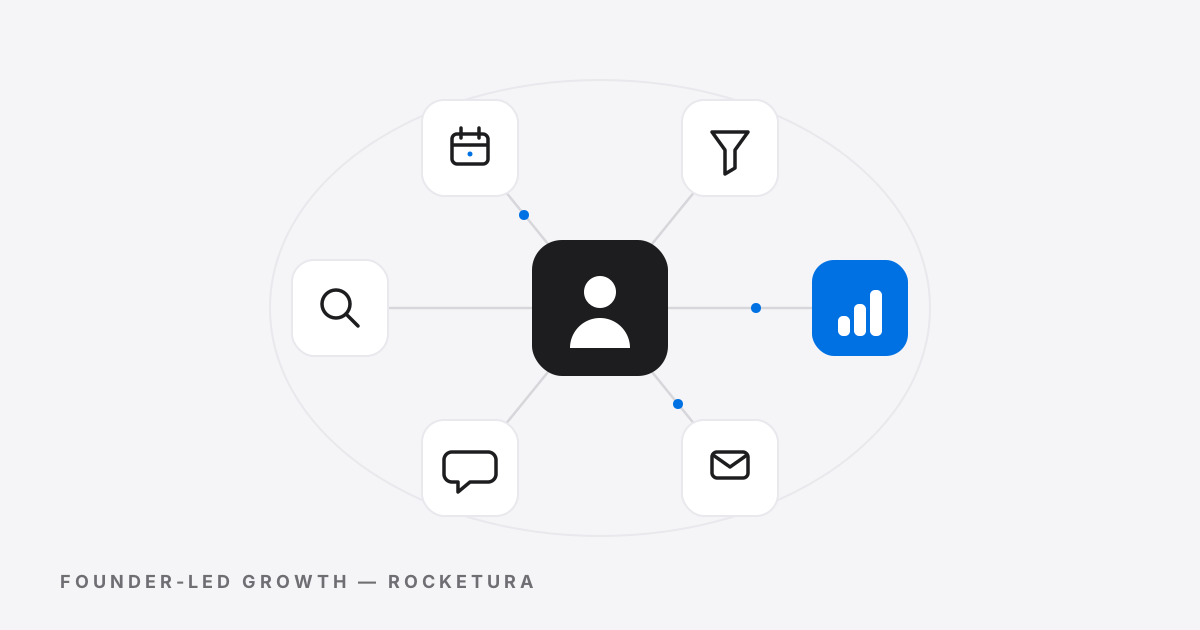
Founder-led growth means the founder owns the inputs that only the founder can supply, and a system carries everything else:
- The founder supplies: the point of view, the buyer knowledge, the offer, the judgment calls, and the voice the messaging is built from.
- The system carries: outreach infrastructure, campaign execution, booking workflows, follow-up sequences, CRM stages, reminders, and reporting.
Done properly, the founder spends a few focused hours a week at the growth desk — reviewing replies, refining the message, showing up on the calls that matter — while the machinery runs whether or not the founder is having a good week. That is the difference between founder-led and founder-dependent. One scales. The other collapses the first time you take a real vacation.
Why the $1M–$10M Band Is Different
Under $1M, you mostly need at-bats, and hustle covers a multitude of sins. Past $10M, you can afford real brand investment and an internal team, and delegating whole functions starts to make sense.
The band in between is the awkward stage. You have real revenue and real operational complexity, but not enough headcount to absorb a bad marketing year. Every dollar of growth spend has to convert. This is precisely where renting generic activity hurts the most — and where a system built around the founder compounds the fastest, because the credibility already exists. It just is not wired to anything.
Where Outside Help Does Belong
None of this means do everything in-house. It means the system is yours and specialists plug into it — not the other way around.
Outside help works when it is scoped execution inside your operating system: technical SEO, ad management, design, deliverability setup, data enrichment. It fails when it is handed the whole engine — the message, the targeting, the follow-up, and the numbers — because then the engine walks out the door at the end of the contract, and you are back to zero with nothing documented.
A useful test before signing any growth engagement: if we stopped paying in six months, what would we still own? If the honest answer is "a login and some reports," you are renting. If the answer is "a documented persona, working outreach infrastructure, CRM stages, follow-up automation, and a revenue dashboard," you are building.
The Practical Sequence
If growth is still running on referrals and founder hustle, the order of operations matters:
- First, capture the founder's voice and buyer knowledge in writing — personas, objections, proof, reasons to respond. This is the raw material everything else is built from.
- Second, seal the leaks — intake speed, follow-up sequences, CRM stages, proposal tracking. More leads into a leaking pipeline is wasted money.
- Third, build the outreach and visibility engine on that foundation, in the founder's voice, pointed at a documented persona.
- Fourth, instrument it so you can see what every channel produces in booked revenue, not impressions.
This is the sequence behind our Growth Desk OS work, and it is the reason we keep saying the same thing to founders who ask whether they should hire an agency: the question is not agency versus in-house. The question is whether growth will run on a system you own — with the founder's credibility wired into it — or on rented activity that resets to zero every time the contract does.
At this stage of the company, that choice is usually the whole ballgame.