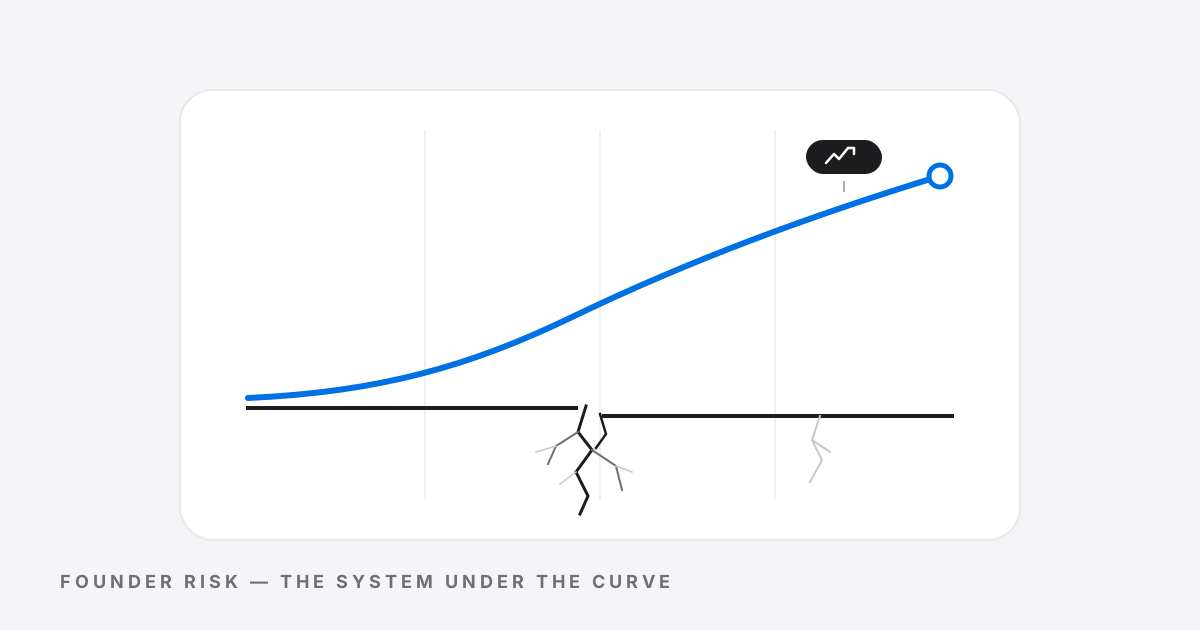
Founders spend most of their worry budget on the market: competitors, pricing pressure, demand drying up. But watch enough founder-led companies stall and a different pattern shows up. The market rarely gets the first shot. Internal failure modes fire first — and growth is what pulls the trigger.
That is the uncomfortable core of founder risk. Growth creates opportunity, and it also exposes risk. Every new lead, hire, and location adds load to systems that were held together by the founder's personal attention. The failure was there all along. Growth just found it.
Here are the six failure modes we see most often, in the rough order they tend to fire.
1. Founder Dependency: The Single Point of Failure
The most common and the most dangerous. Every lead, reply, proposal, and decision routes through one person. It works — right up until volume rises. Then response times stretch, follow-ups slip, and quality wobbles based on how the founder's week went.
The cruel part is that this failure mode is caused by success. The founder is the best closer, the best writer, the best judge of a deal — so everything keeps routing to the founder, and the ceiling of the company becomes the ceiling of one person's calendar.
The diagnostic question: if you stepped away for thirty days, what would still move? Whatever stops is not a business function yet. It is a founder function wearing a business costume.
2. Invisible Pipeline: Nobody Actually Knows the Numbers
Ask for the pipeline and you get a feeling: "pretty good month coming." The real state lives across an inbox, a notebook, a half-updated CRM, and the founder's memory. Nobody can say how many open opportunities exist, what stage they are in, or what they are worth.
An invisible pipeline fails twice. Day to day, deals rot silently because nothing flags them. Strategically, every decision — hiring, spend, expansion — is made on vibes instead of numbers. Companies routinely discover, once the pipeline is finally documented, that they had more revenue sitting in stalled deals than they were spending to generate new ones.
3. Follow-Up Decay: Where Revenue Actually Dies
Most founder-led companies do not have a lead problem. They have a follow-up problem wearing a lead problem's clothes. The inquiry gets answered in two days instead of five minutes. The great call never gets a recap. The proposal goes out and nobody touches it again. The prospect who said "check back next quarter" is never checked back with.
None of these losses show up anywhere, which is what makes this failure mode so quiet. A lost deal you fought for teaches you something. A deal that evaporated from neglect teaches you nothing — it just disappears. Multiply by every month you have been in business, and follow-up decay is usually the single largest leak in the company.
4. Message Drift: The Voice That Built the Company Stops Showing Up
The founder's specific point of view won the early clients. Then delegation and outsourcing arrive, and the message drifts generic — the website could belong to any competitor, the outreach reads like a template, and response rates sag. The company keeps marketing, but the reason people used to respond has been diluted out of the material.
This one is subtle because activity stays constant while effectiveness falls. The fix is not the founder writing everything forever. It is capturing the voice — personas, objections, stories, proof — as a documented asset that other people and systems can faithfully execute from.
5. Channel Fragility: One Source Feeding the Whole Company
Referrals only. Or one big client. Or one ad account, one ranking, one platform. It works well enough that building a second source never feels urgent — until the algorithm shifts, the anchor client churns, or the referral network quietly ages out. Demand drops 40% in a quarter and the company learns it never had a growth system, just a lucky faucet.
The danger is not having a strong channel. It is having no instrumentation that would even tell you how concentrated you are, and no second engine warming up while the first one still works.
6. Undocumented Operations: The Company That Lives in People's Heads
How is a lead handled? Depends who picks it up. How is a job scoped, priced, delivered? Ask the founder, or the one senior person who has been around long enough to know. Nothing written, nothing repeatable.
Undocumented operations put a hard cap on growth: every new hire takes months to become useful because there is nothing to train from, quality varies by person, and the departure of one key employee can set the company back a year. This is the failure mode that turns a growth surge into an operational collapse — more demand arrives, and the only way to serve it is to work the same three heads harder.
Why These Fire Before the Market Does
Notice what these six have in common. None of them require a competitor. None of them require a downturn. They are all self-inflicted, they all hide during slow periods, and they all get worse with volume. That is why growth — the thing founders want most — is so often the trigger. The market usually just finishes the job the internal failure started.
The response is not to fear growth. It is to audit for these failure modes deliberately, the way you would audit finances:
- Map each stage from first touch to paid invoice, and name who owns it besides the founder.
- Put the pipeline in one visible place, with stages and values, even if it is ugly at first.
- Time-stamp your follow-up: response speed, touches per opportunity, and how deals get closed out.
- Write the voice down — personas, objections, proof — so the message survives delegation.
- Measure channel concentration honestly, and start the second engine before you need it.
- Document the three processes that would hurt most if their owner left tomorrow.
We wrote a fuller version of this thinking in the Founder Risk Framework, and it is the lens behind everything we build at the Growth Desk: the goal is not just more pipeline. It is a company where growth exposes strength instead of fragility.
Your competitors are probably not going to kill your growth. Left unaddressed, these six things will do it first — quietly, internally, and on your own payroll.