Ask a founder what their marketing plan is and you usually get a list: post more on LinkedIn, restart the newsletter, try cold email again, fix the website, ask for referrals. Every item is reasonable. The list as a whole produces almost nothing.
That is not a discipline problem. It is a structure problem. A to-do list has no memory, no sequence, and no feedback loop. When a week gets busy — and in a founder-led company every week gets busy — the list simply stops, and marketing stops with it. Then a slow month arrives, panic sets in, and the list starts over from zero.
We call the alternative a growth desk: marketing run as an operating system. Here is what that actually means, stripped of the software branding.
A To-Do List Versus an Operating System
An operating system has properties a task list never will:
- It runs on a cadence, not on motivation. Certain things happen every week whether or not the founder feels inspired.
- It has stages with owners. Every lead, reply, call, and proposal is in a named stage, and someone — or something — is responsible for moving it.
- It is instrumented. You can see what went in, what came out, and where things died in between.
- It compounds. This month's work builds on last month's instead of replacing it.
The test is simple: if you disappeared for two weeks, would marketing keep running? A list stops. A system keeps moving.
The Six Functions of a Growth Desk
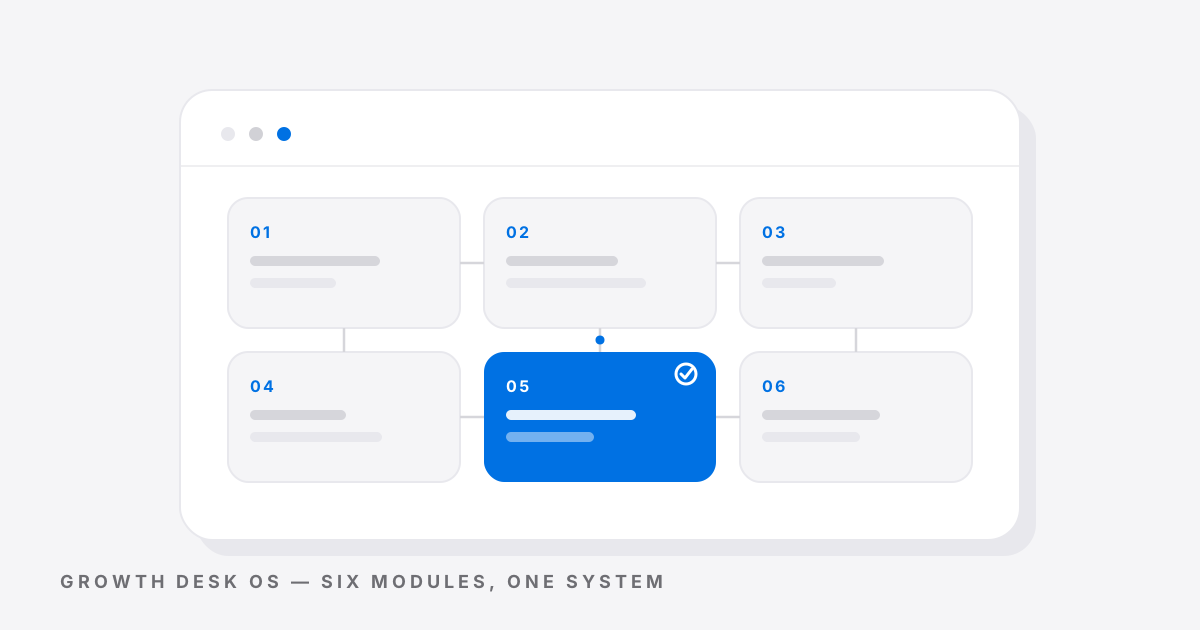
Strip any working growth system down to its skeleton and you find the same six functions. Most companies have two or three of them, disconnected. The gaps between them are where revenue leaks.
1. Persona intelligence
Written answers to the questions everything else depends on: who the buyer is, what pain they wake up with, what objections they raise, why they would respond to you specifically, and what proof convinces them. If this only exists in the founder's head, nothing can be delegated — every email, page, and pitch has to route through one person.
2. Outreach and visibility infrastructure
The plumbing that makes demand generation possible: sending domains and inboxes for outbound, search and local visibility for inbound, review and proof assets for trust. Unglamorous, and the reason most "we tried cold email" stories end badly — the campaign ran on infrastructure that was never built.
3. The campaign engine
The repeatable process that turns targeting into conversations: list building, messaging in the founder's actual voice, sequences, and a schedule. Not a heroic one-time push. A loop that runs weekly at a sustainable volume.
4. Content and authority
The assets that make a cold conversation warmer: the landing page that matches the pitch, the case study that answers the doubt, the founder's point of view in public. Content on a growth desk is not a channel chasing reach. It is ammunition for conversations already in motion.
5. Follow-up and CRM control
Where the most revenue dies. Speed to first response, automated reminders, defined pipeline stages, and a rule that nothing gets abandoned silently — every opportunity is either moving, scheduled, or deliberately closed. Most companies do not need more leads nearly as much as they need this function.
6. Revenue intelligence
One view that connects activity to money: opportunities created, calls booked, proposals out, revenue won, and where each came from. Without it, every marketing decision is a vibe. With it, the Monday review takes fifteen minutes and ends in decisions.
The Cadence That Makes It Real
Functions on paper are still just a nicer to-do list. What turns them into an operating system is a fixed weekly rhythm. Ours, simplified:
- Monday — numbers first. Fifteen minutes on the dashboard: what moved, what stalled, what needs a decision. Not a status meeting. A decision meeting.
- Midweek — the founder hour. The founder does the two things only the founder can do: reviews live replies to keep the voice honest, and feeds the desk raw material — an objection heard on a call, a story worth turning into content.
- Friday — pipeline hygiene. Every open opportunity gets touched, rescheduled, or closed. Nothing is allowed to rot quietly.
That is roughly three founder-hours a week. The system runs the rest: sequences send, reminders fire, dashboards update. Compare that to the founder-as-marketing-department model, where twenty scattered hours produce less than these three structured ones.
What changes under this rhythm is subtle but decisive. Marketing stops being a project the founder restarts every quarter and becomes a desk the company staffs — with software, automation, and people slotted into defined roles. Delegation finally works, because there is a documented system to delegate into. And slow months stop triggering panic pivots, because the dashboard shows exactly which function slipped and by how much.
Where to Start Without Boiling the Ocean
Do not build all six functions at once. Start where the money already is: follow-up and CRM control, then revenue intelligence. Sealing the leaks in your existing pipeline is the fastest ROI in marketing, because those opportunities are already paid for. Then build persona intelligence, then infrastructure, then the campaign engine on top. Visibility last is counterintuitive — and correct. Pouring new demand into an unmanaged pipeline just makes the leak bigger.
This sequence is the core of how we build a Growth Desk OS for founder-led companies, and it is why we keep repeating the same line: it is not just a cold email service. It is the desk behind the pipeline.
Marketing run as a list will always lose to marketing run as a system — not because the list-keeper works less, but because the system never forgets, never skips a week, and never stops counting.